
TL;DR: Recorded statements given to insurance adjusters after an accident are used to lock in a version of events, identify coverage defenses, and minimize claim value. Once recorded, the words become evidence that can be used to challenge injury severity, dispute liability, or justify a denial. Understanding what happens to these statements and how they function in the claim process matters before the record button is ever pressed.ers before the record button is ever pressed.
An accident ends. The other driver’s insurance company calls. The adjuster sounds friendly, sympathetic even, just needs to “get your side of the story” while things are fresh. The conversation feels informal. But the moment that recording starts, every word becomes a permanent part of the claim file, available to adjusters, defense attorneys, and potentially a jury. The statement is not being taken to help the injured person. It is being taken to build the insurer’s case.
Recorded statements serve several purposes within the insurance claim process, none of which prioritize the injured person’s recovery or full compensation. Recognizing what these statements are used for and how they function long after the phone call ends provides clarity in a moment when most people assume cooperation equals fairness.
Establishing a Fixed Account of the Accident
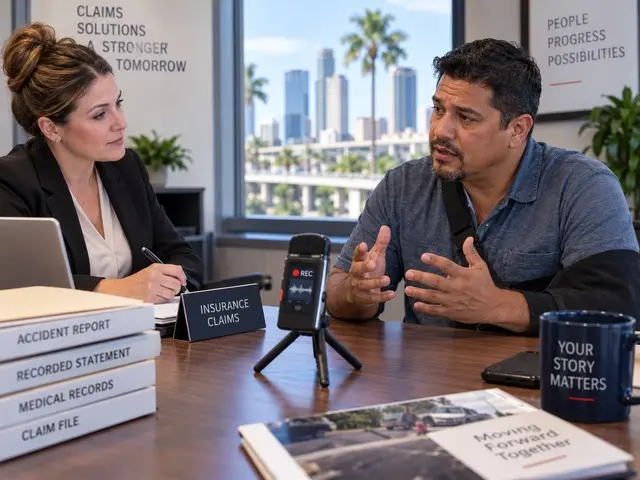
The first and most straightforward purpose of a recorded statement is to lock in a narrative. Insurance adjusters request statements within days of an accident, often before the injured person has spoken with an attorney, received a full medical evaluation, or even processed what happened. At that point, memory is fragmented. Shock and adrenaline distort perception. Minor details may be wrong. Sequence may be unclear. But once those details are spoken aloud and recorded, they become the official version.
If the injured person later recalls additional facts, such as seeing the other driver on a phone, or feeling pain that did not appear until days later, the insurance carrier will compare the new information against the recorded statement. Any inconsistency, no matter how minor or understandable, becomes grounds to question credibility. The adjuster’s early-stage friendliness is designed to encourage openness. The recording ensures that openness can be used against the person who offered it.
Assessing Fault and Comparative Negligence
Florida operates under a modified comparative negligence system, codified in Florida Statutes § 768.81. Under this framework, a person’s recovery is reduced by their own percentage of fault, and if that percentage is greater than 50 percent, recovery of damages is barred entirely. Recorded statements are a primary tool for shifting fault percentages onto the injured party.
Consider a driver making a left turn on a green light, not a protected arrow, who is struck by an oncoming car. In the recorded statement, the adjuster asks, “How far away was the other car when you started your turn?” The driver, trying to be honest while still in shock, might say, “I’m not sure, it seemed far enough away, but it was coming pretty fast.” An adjuster can reframe that answer to argue the turning driver failed to yield the right-of-way and is partially at fault, even if the other driver was speeding. The insurer then uses that admission to assign a percentage of blame to the injured driver, reducing the recovery available.
Adjusters are trained to extract admissions that can be reframed as fault. Questions are phrased to sound neutral but are designed to capture doubt, hesitation, or uncertainty. The recording preserves those moments and allows the carrier to build a fault narrative that serves its financial interest.
Minimizing Injury Claims Through Early Admissions
Injuries often take time to manifest. Soft tissue damage, concussion symptoms, and herniated discs may not produce noticeable pain immediately after an accident. When an adjuster calls within 24 to 48 hours and asks, “How are you feeling?” or “Were you hurt?”, the injured person may truthfully respond that they feel sore but okay. That response, captured on the recording, later becomes evidence that the injury was minor or nonexistent.
Weeks later, when an MRI reveals a herniated disc or when headaches become debilitating, the insurance carrier points to the recorded statement. The adjuster argues that the serious injury must have been caused by something else, a pre-existing condition, a later incident, or exaggeration. The early statement, given before medical evaluation, is used to deny or minimize the value of a personal injury claim.
This tactic is especially common in cases involving:
- Whiplash and cervical strain
- Traumatic brain injury with delayed symptoms
- Back injuries that worsen over time
- Psychological trauma such as anxiety or PTSD
The injured person’s own words, spoken in good faith and without full medical knowledge, are repurposed to undermine the claim’s legitimacy.
Identifying Coverage Defenses and Claim Denials
Recorded statements also serve as a discovery tool for coverage defenses. Adjusters listen for facts that may allow the insurer to deny the claim outright, such as policy exclusions, late notice, or misrepresentations on the application. A seemingly innocent question, “Where were you going when the accident happened?” may reveal that the injured person was using a personal vehicle for work purposes, which some policies exclude from coverage.
Similarly, questions about prior accidents or medical treatment are designed to uncover pre-existing conditions or previous claims. If the injured person mentions a past back injury, the insurer may argue that the current damage is not new and therefore not compensable. If the person failed to disclose information the insurer considers material to the policy, the carrier may assert misrepresentation and attempt to contest or rescind coverage.
The adjuster is not taking notes to build sympathy. The adjuster is building a file for denial, reduction, or litigation defense.
Creating Impeachment Material for Trial
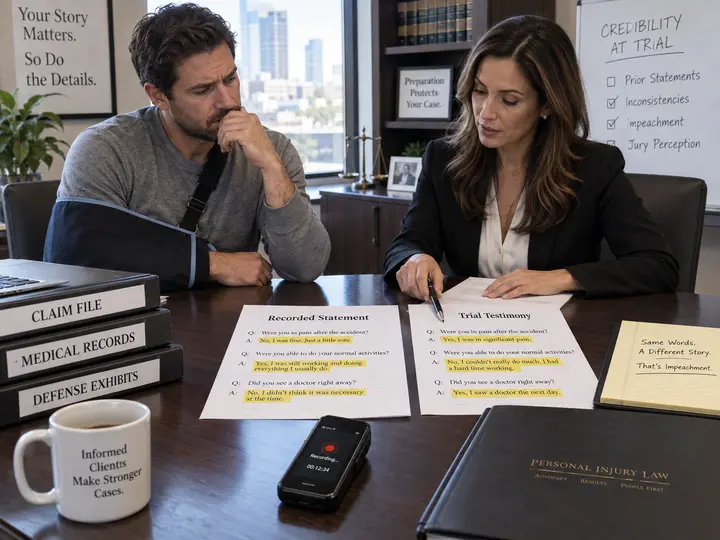
If a case proceeds to litigation, the recorded statement generally becomes a discoverable document available to defense counsel. Any inconsistency between the statement and later testimony, whetherin a deposition, at trial, or in medical records, can be used for impeachment. Witnesses are cross-examined with their own words. Juries may hear the recording. Credibility, once damaged, is difficult to restore.
Even minor discrepancies take on outsize importance. A person may describe the impact as occurring “pretty fast” in the recorded statement and later testify that it was “sudden and violent.” Defense counsel will argue that the description changed to inflate damages. The recorded statement, given in the emotional aftermath of an accident and without legal counsel, is often treated as the more reliable account, not because it is more accurate, but because it was captured first.
This dynamic is why many injured people are advised to decline recorded statements, or to provide them only with representation present. The insurer knows this. That is why adjusters push for early statements and frame a refusal as uncooperative or suspicious.
Recorded statements are not neutral fact-gathering exercises. They are strategic tools used to limit liability, reduce claim value, and create evidence for denial or litigation. The adjuster’s tone may be warm. The questions may sound reasonable. But the purpose is singular: to protect the insurer’s financial interest, often at the expense of the injured person’s right to full and fair compensation. Recognizing that purpose before the phone rings changes everything about how that conversation should be handled.
Closing Remarks
If you have been asked to give a recorded statement, or if one is already being used against you, you do not have to face this alone. At CDB Injury Law, we help restore clarity and control when insurance companies try to minimize what you have been through. Let us talk about your recovery and how to protect it. You can reach us at (727) 656-7852.
Frequently Asked Questions
Is giving a recorded statement required after a car accident in Florida?
A recorded statement is generally only expected when requested by the injured person’s own insurance carrier under a first-party policy, such as Personal Injury Protection coverage under Florida’s no-fault law. There is typically no legal obligation to provide a recorded statement to the at-fault driver’s insurer. Cooperation clauses in most policies require reasonable cooperation, which can often be satisfied by providing information in writing or through counsel, rather than an on-the-spot recording without representation. Because policy language varies, a lawyer should review the specific policy before any statement is given.
Can a recorded statement be used against me in court?
Yes. Recorded statements become part of the claim file and are generally discoverable in litigation. Defense attorneys use them for impeachment if any detail in the statement conflicts with later testimony or evidence. Even minor inconsistencies, caused by stress, incomplete memory, or lack of medical knowledge at the time of the statement can be presented to a jury as evidence of exaggeration. Once recorded, the statement does not go away.
What happens if I refuse to give a recorded statement?
Declining to provide a recorded statement to the other driver’s insurer usually carries no penalty, because that carrier has no contractual relationship with the injured person and generally cannot compel cooperation. If the request comes from the injured person’s own insurer under a first-party policy, a refusal may raise coverage issues depending on the policy’s cooperation clause. In that situation, offering to provide the information through legal counsel or in written form often satisfies the insurer’s legitimate need without creating unnecessary risk.
This information is general in nature and is not legal advice. Every claim depends on its own facts and policy language.
Should I have a lawyer present before giving a recorded statement?
Having legal representation before giving any recorded statement helps protect against inadvertent admissions, clarifies which questions must be answered, and reduces the chance that the statement is used to mischaracterize fault or injury. Adjusters often push for immediate statements precisely because unrepresented people do not yet understand how their words will be used. Consulting counsel first is not obstructive; it is prudent. The insurer’s interest is in minimizing payout. Legal guidance helps level that imbalance.
References
- Florida Statutes § 768.81 ((Comparative fault).