


TL;DR: Lost wage claims compensate for income missed due to accident-related injuries, including hourly pay, salary, commissions, bonuses, and self-employment earnings. Documentation such as pay stubs, tax returns, and employer letters establishes the amount. Both past lost wages and future earning capacity may be recovered when medical evidence supports continued impairment.
Paychecks stop. Bills do not. An accident that causes injury does not pause financial obligations, rent, groceries, insurance premiums, yet the ability to earn disappears the moment pain, treatment schedules, or recovery needs prevent work. Lost wage claims exist to bridge that gap, but understanding what qualifies and how to prove it determines whether compensation reflects the full scope of the disruption or falls short when it matters most.
The law recognizes that injury steals more than health. It steals time, productivity, and the income those hours would have generated. Lost wage claims address the economic harm that follows physical harm, compensating for earnings forfeited because of someone else’s negligence. The principle is straightforward: if the accident had not occurred, the income would have been earned. But translating that principle into a documented, defensible claim requires clarity about what counts, what does not, and how to prove the difference. You do not have to sort that out alone.
What Qualifies as Lost Wages
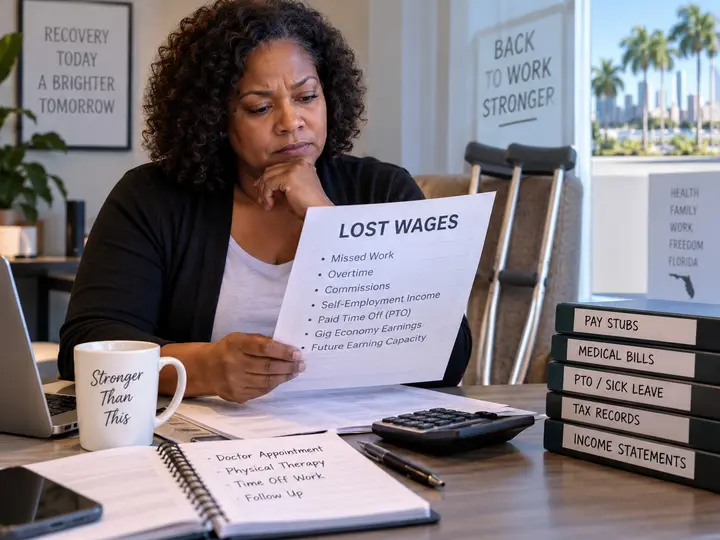
Lost wages encompass any income an injured person would have earned but could not because of accident-related injuries. The category is broader than many assume. It includes:
- Hourly wages and salary missed during medical appointments, hospital stays, or recovery periods when work was impossible.
- Overtime and shift differentials that would have been worked based on documented patterns or scheduled shifts.
- Commissions, bonuses, and tips tied to performance or attendance that the injury prevented.
- Self-employment income lost when the injury halted business operations, client work, or contract performance.
- Paid time off (PTO) or sick leave depleted to cover injury-related absences, reducing available time for personal use or emergencies.
- Freelance and gig economy earnings from jobs or shifts the injured person could not complete.
The common thread: the income would have been earned in the ordinary course but for the accident. Future wage loss, also called loss of earning capacity, extends the claim forward when injuries cause permanent impairment, reduced work hours, or the inability to return to a previous occupation. Personal injury claims often hinge on demonstrating both the injury and the economic ripple it creates.
One Florida-specific note matters here. In crashes involving motor vehicles, Florida’s no-fault system requires personal injury protection (PIP) coverage to pay a portion of lost wages, generally 60 percent of lost income, subject to the policy’s overall benefit limit, regardless of who caused the collision. PIP is a starting point, not the finish line. When injuries are serious, the balance of lost income is pursued from the at-fault party. Knowing how those two sources fit together keeps money from being left behind.
Proving Past Lost Wages
Insurance adjusters and opposing counsel do not accept verbal assertions of lost income. Documentation transforms the claim from statement to proof. For employees, the following records establish past lost wages:
- Pay stubs showing gross income before the accident, creating a baseline of typical earnings.
- Employer verification letters confirming dates of absence, hourly rate or salary, and income missed due to injury.
- W-2 forms or 1099s illustrating annual income and patterns of earnings.
- Time-off requests and medical release forms linking absences directly to accident-related treatment or recovery.
Self-employed individuals carry a heavier documentation load. Without an employer to verify income, proof relies on tax returns, profit-and-loss statements, bank records, invoices, and contracts demonstrating revenue lost during recovery. Consistency across documents strengthens the claim. Gaps, discrepancies, or informal income streams complicate valuation, often requiring forensic accounting or testimony from business experts to establish the baseline and calculate the shortfall.
Medical records tie lost time to the injury. Treatment dates, work restrictions, and physician statements about the inability to perform job duties connect the absence to the accident. Without that medical nexus, the claim for lost income falters; even when the financial loss is real.
Future Earning Capacity and Long-Term Impact
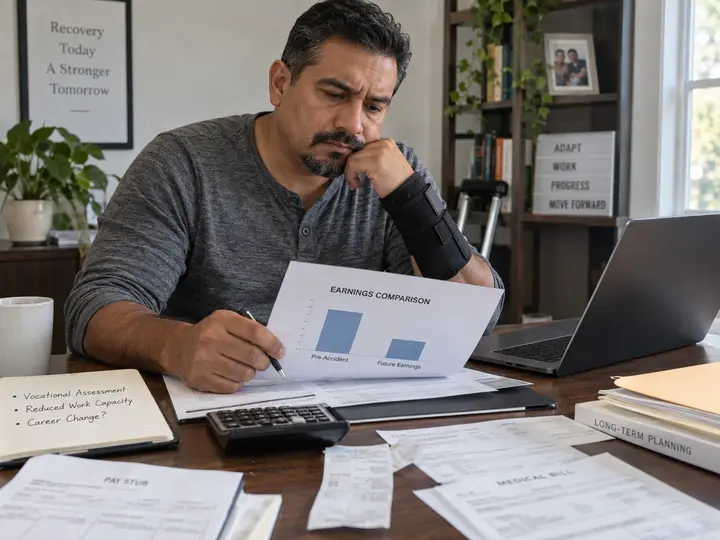
Some injuries heal. Others do not. When permanent impairment prevents return to the same occupation, limits work hours, or reduces the capacity to earn at pre-accident levels, the claim extends beyond past wages to future earning capacity. This component addresses the long-term economic harm caused by lasting physical or cognitive limitations.
Calculating future loss requires comparison: what the injured person would have earned over a career versus what they can now earn given their limitations. Variables include age, occupation, education, skill set, work-life expectancy, and the severity of permanent restrictions. Vocational experts analyze transferable skills and residual capacity. Economists project lifetime earnings and reduce future losses to present value, as Florida’s standard jury instructions on damages contemplate.
Florida law permits recovery for diminished earning capacity even when the injured person returns to work at lower pay or in a different role. The measure is not whether employment continues, but whether the injury reduced what could have been earned. Promotion opportunities foreclosed, physical tasks no longer possible, and stamina limits that reduce productivity all factor into the analysis. Understanding how comparative negligence affects a payout becomes important when the injured party bears any degree of fault, because a damages award, including wage loss, is reduced in proportion to that share of fault.
Navigating Challenges in Lost Wage Claims
Building a strong lost wage claim means working through demanding documentation requirements, especially when your financial life does not fit into a neat box. Insurance companies scrutinize these areas closely. We are prepared to meet those challenges with you.
Proving Informal or Cash-Based Income. Many hardworking people in Florida earn income from tips, freelance work, or cash-based jobs. That income is real, but proving it without traditional pay stubs can be difficult. We help clients gather alternative evidence, tax returns, bank deposits, client affidavits, and business records, to build a credible picture of the income you have lost.
The Pressure to Return to Work Prematurely. Financial strain can create immense pressure to go back to work before you are medically ready. We understand that dilemma. Returning too soon can signal to an insurer that your injuries are not severe and can undermine your claim. We help you keep your focus on recovery by making sure your claim reflects the full period of doctor-recommended absence.
Documenting Variable or Sporadic Income. For those in the gig economy, sales, or seasonal industries, income often fluctuates. Insurers may point to the lowest earning periods to undervalue a claim. Our approach is to establish a fair and accurate baseline by averaging earnings over a representative period, so your claim reflects your true earning history rather than a snapshot in time.
Accounting for Used Sick Leave and PTO. When you are forced to use paid time off or sick leave for an injury, you are losing a valuable, earned benefit. That time is no longer available for a family vacation or a future illness. It is a real economic loss, and it is often overlooked. We work to include the value of that depleted leave as part of your total lost wage claim.
Strengthening Medical Support for Work Restrictions. A doctor’s note saying “light duty” rarely satisfies an insurance company. Adjusters demand specifics. We work with your medical providers to obtain clear, detailed documentation of your exact limitations, lifting restrictions, limits on standing, or cognitive demands, to draw a firm line between your injury and your inability to perform your job.
How Lost Wages Fit Into the Larger Settlement
Lost wage claims rarely stand alone. They form one component of economic damages, which also include medical expenses, out-of-pocket costs, and property damage. Noneconomic damages, pain and suffering, loss of enjoyment of life, add further value. The two categories combine to define the settlement range, and lost wages often anchor the economic harm argument.
Insurance adjusters scrutinize wage claims because they are quantifiable and easily challenged. Strong documentation not only secures the lost wage component but also lends credibility to the entire claim. When economic damages are well-supported, the case for noneconomic damages carries more weight. When wage claims are weak or speculative, the entire settlement offer contracts.
Subrogation liens and collateral sources intersect with lost wages as well. If short-term disability insurance, PIP wage benefits, or employer-provided sick pay covered some lost income, those payments may reduce the net recovery or trigger reimbursement obligations. The goal is full compensation, not double recovery, and understanding which offsets apply, and which do not, protects the final settlement amount.
Timing matters. Lost wage claims strengthen as documentation accumulates, but waiting too long to gather records allows memories to fade, employers to change systems, and gaps to widen. Florida also sets deadlines for filing suit, and those deadlines vary by the type of claim, so an early conversation protects your options. Building the claim in real time, requesting verification letters promptly, preserving pay records, and maintaining treatment documentation, supports the fullest possible recovery when settlement or trial arrives.
Closing Remarks
If an accident has caused missed shifts, depleted savings, or restrictions that limit your work, if treatment schedules conflict with your job, or if permanent impairment threatens what you can earn for years to come, the financial harm is real and the law provides a remedy. CDB Injury Law works with injured people across Florida to document, value, and recover lost wages as part of a full personal injury claim. You do not have to face this alone. Let us talk about your recovery, and the compensation that supports it.
Frequently Asked Questions
Can self-employed individuals recover lost wages after an accident?
Yes. Self-employed individuals can recover lost income, but the documentation burden is heavier. Tax returns, profit-and-loss statements, bank records, client invoices, and contracts help establish baseline income and the revenue lost during recovery. Consistency across records strengthens the claim, and testimony from accountants or business valuation professionals often supports larger claims when informal or variable income is involved.
Does using sick leave or PTO count as a lost wage?
Generally, yes. When paid time off or sick leave is used to cover injury-related absences, that banked time, previously available for vacation, personal matters, or future illness, is depleted. The loss of that earned benefit has economic value and is routinely presented as part of a lost wage claim. Employer documentation confirming the amount of leave used and its cash-equivalent value supports recovery.
What if the injury prevents return to the same job but work is still possible in another role?
Florida law permits recovery for diminished earning capacity even when some work remains possible. The measure is the difference between what would have been earned in the original occupation and what can now be earned given the injury-related limitations. Vocational experts assess transferable skills, and economists project the lifetime income gap. Promotion opportunities foreclosed, reduced hours, and lower-paying roles all factor into the calculation.
How far into the future can a lost wage claim extend?
Future wage loss may extend through the injured person’s expected work life, often projected toward retirement age. The analysis accounts for wage growth and work-life expectancy, and future losses are reduced to present value. Permanent impairment, supported by medical evidence and vocational assessment, justifies the forward-looking component. The more severe and better documented the permanent restrictions, the stronger the future earning capacity claim.
Can lost wages be recovered if the injured person was paid in cash or did not report all income?
Recovery becomes significantly harder without documentation, and no claim should ever be built on inaccurate statements about income. Informal or unreported income lacks the paper trail that insurers and courts require. If tax returns show consistent income, affidavits from clients or employers corroborate work performed, and business records or bank deposits reflect cash flow, partial recovery may be possible. The burden remains on the claimant to prove the income existed and was lost because of the accident.
Does Florida PIP pay for lost wages after a car accident?
Yes, in part. Florida’s no-fault personal injury protection coverage pays a percentage of lost income, commonly 60 percent, along with medical benefits, up to the policy’s total benefit limit, regardless of fault. Because PIP covers only a portion of the loss and is capped, the remainder of the wage loss is typically pursued against the at-fault driver when the injury meets Florida’s threshold for a bodily injury claim.
References
- Fla. Stat. § 627.736 (Florida Motor Vehicle No-Fault Law, Required Personal Injury Protection Benefits (disability benefits equal to 60 percent of lost gross income)).
- Fla. Stat. § 768.81 (Comparative Fault).