


TL;DR: Pre-existing medical conditions do not eliminate the right to recover compensation after an injury caused by someone else’s negligence. Florida law recognizes thatdefendants take injured parties as they find them, meaning negligent parties remain responsible for aggravating or worsening conditions that existed before the incident. The challenge lies in proving which symptoms stem from the new trauma versus the prior condition.
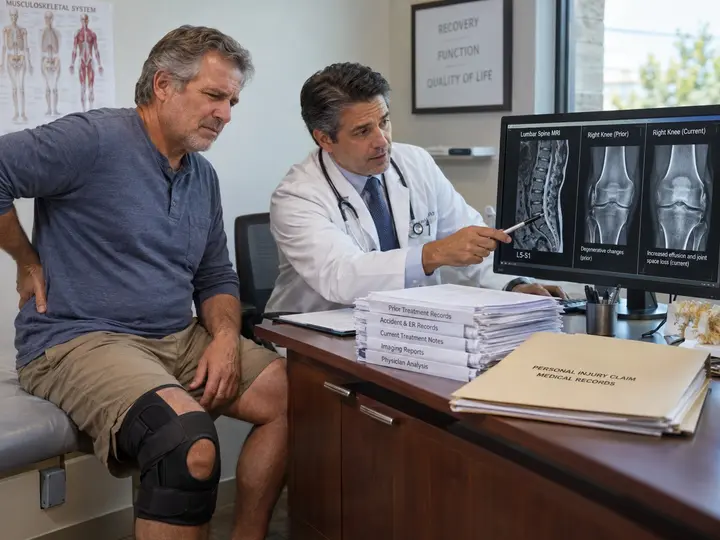
A back that ached before the collision. A knee that had been surgically repaired years earlier. Chronic migraines documented in medical records long before the fall. When an accident happens, pre-existing conditions become battlegrounds. Insurance adjusters scrutinize old treatment notes, searching for reasons to discount the claim. The question is not whether prior injuries existed, it is whether the new incident made everything worse, and whether that worsening deserves compensation.
Florida law does not require a person to be in perfect health before an injury claim becomes valid. The principle is straightforward: a negligent party cannot escape responsibility simply because the injured person was already vulnerable. But proving the distinction between old pain and new harm requires more than subjective complaints. Medical documentation, diagnostic imaging, and expert testimony become the tools that separate legitimate aggravation from baseline symptoms.
How Florida Law Treats Pre-Existing Conditions in Injury Claims
The “eggshell plaintiff” doctrine forms the foundation. It holds that a defendant takes a plaintiff as they find them, fragile spine, weakened joints, or otherwise. If a rear-end collision aggravates a herniated disc that was asymptomatic for years, the at-fault driver does not get credit for the fact that the disc was already compromised. The focus shifts to what changed after the incident.
This principle extends across all personal injury contexts in Florida, car accidents, slip and fall incidents, and other negligence claims. The existence of a prior condition does not bar recovery. It does, however, create evidentiary challenges. Insurance adjusters will compare pre-accident medical records with post-accident treatment notes, looking for overlap. Any treatment gap, symptom similarity, or diagnostic finding that mirrors the earlier condition becomes ammunition to argue that the claim overstates the new injury’s severity.
Causation becomes the central issue. Medical evidence must demonstrate that the accident caused a distinct worsening, new pain, increased limitations, additional structural damage visible on MRI or CT scan. Generalized complaints that echo prior symptoms rarely survive scrutiny. Objective findings carry weight: a new tear in tissue previously intact, progression from bulging disc to herniation, or range-of-motion loss measured against baseline function documented before the incident.
What Counts as Aggravation vs. Baseline Condition
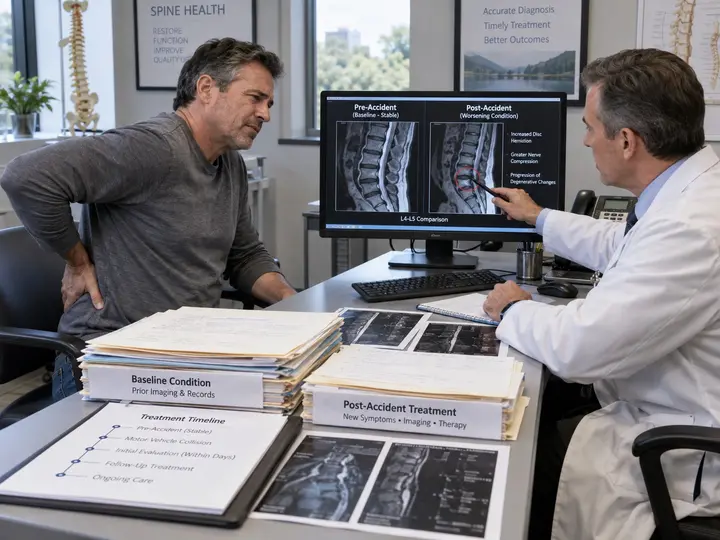
Aggravation means the accident made a pre-existing condition worse in a measurable, documented way. Baseline condition refers to the state of health immediately before the incident. The dividing line determines what portion of medical bills, lost wages, and pain stems from the new trauma versus the old injury.
Consider a hypothetical: a person with degenerative disc disease managed pain through occasional physical therapy and over-the-counter medication. After a rear-end collision, that same person requires epidural injections, prescription pain management, and eventually spinal fusion surgery. The degenerative condition existed, but the accident accelerated deterioration and triggered interventions that were not previously necessary. That acceleration is compensable.
Insurance carriers often argue that the accident merely revealed a condition that would have required treatment eventually. This argument weakens when medical records show a stable, managed condition prior to the incident and a sharp decline afterward. Treatment frequency, diagnostic progression, and functional limitations documented in physician notes become the evidence that separates aggravation from inevitable decline.
Timing matters. A gap between the accident and the onset of new treatment undermines the claim of aggravation. If six months pass before a person seeks care for worsened back pain, adjusters will question whether the accident caused the decline or whether age, wear, or unrelated activity explains it. Prompt medical evaluation after the incident creates a timeline that links the trauma to the symptoms.
Medical Documentation That Strengthens an Aggravation Claim
Pre-accident medical records become both asset and liability. They establish baseline function, which can demonstrate how much worse things became. But they also give the defense a roadmap of prior complaints. The key is ensuring post-accident records clearly document changes.
- Comparative imaging studies showing new or worsened structural damage
- Physician narrative explaining how the accident altered the clinical picture
- Treatment escalation, shift from conservative care to invasive procedures
- Functional assessments measuring range of motion, strength, or mobility before and after the incident
- Pain scales and symptom diaries tracking intensity and frequency over time
A treating physician’s opinion carries significant weight when it directly addresses causation. A generic note stating “patient reports worsening pain after accident” offers little. A detailed narrative explaining how imaging reveals new tears in previously intact tissue, how symptoms now require medications that were unnecessary before, and how function has declined measurably since the incident builds the evidentiary foundation needed to overcome pre-existing condition arguments.
Expert testimony often becomes necessary. An orthopedic surgeon or neurologist can review the full medical history, interpret imaging studies, and explain to an adjuster, or eventually a jury, how the accident caused distinct, compensable harm separate from the underlying condition. This testimony counters the defense narrative that the person was destined for the same outcome regardless of the accident.
How Insurance Adjusters Use Pre-Existing Conditions to Reduce Settlement Value
Adjusters deploy pre-existing conditions as leverage. The strategy is predictable: minimize the accident’s role, maximize the prior condition’s contribution, and offer a settlement that reflects only a fraction of the total damages. The argument often sounds reasonable on the surface: “We can only pay for what our insured caused, not what was already there.” But this framing ignores the legal duty to compensate for aggravation.
One tactic involves isolating treatment that appears related to the old injury and excluding it from the settlement calculation. If a person treated for chronic knee pain before the accident and continues similar treatment afterward, the adjuster may argue that post-accident orthopedic visits simply continue pre-existing care. Without clear documentation showing increased treatment frequency, new interventions, or worsened diagnostic findings, this argument gains traction.
Another approach questions whether the accident caused any new injury at all. When imaging shows degenerative changes, the adjuster may claim that pain and limitations stem entirely from age-related deterioration. The collision, in this narrative, becomes irrelevant. Overcoming this requires a well-documented timeline: stable condition before impact, sudden symptom onset afterward, and medical opinions linking the trauma to the worsening.
The burden of proof rests on the injured party to show that the accident aggravated the pre-existing condition. Florida’s standard jury instructions direct that a negligent party is responsible for the aggravation itself, and that where the evidence does not permit a jury to separate the effects of the pre-existing condition from the effects of the accident, the defendant may be held responsible for the entire condition. Comparative negligence in Florida addresses each party’s share of fault for causing the crash; it is not a tool for discounting damages simply because an injured person was already vulnerable. In short, proving a distinct worsening of your condition is crucial; unclear documentation can lead to unfairly reduced settlement offers or denied claims.
Proving Causation When Medical History Is Complex
Multiple prior injuries or years of treatment records create layers of complexity. When a spine has been the subject of surgeries, injections, and physical therapy over a decade, isolating the impact of a single accident becomes a puzzle. The challenge is not insurmountable, but it requires precision.
Medical chronology matters. Organizing records into a timeline that shows periods of stability versus decline helps demonstrate that the accident disrupted an otherwise managed condition. If treatment notes reflect that a person was functioning well, working full-time, engaging in recreational activities, reporting minimal pain, immediately before the incident, and then show a sharp downturn afterward, the causal link becomes clearer.
Diagnostic imaging provides objective markers. A prior MRI showing a bulging disc at L4-L5, followed by a post-accident MRI showing a herniated disc with nerve impingement at the same level, offers concrete evidence of worsening. The defense may argue that the bulge was destined to herniate eventually, but medical testimony can explain how trauma accelerates degeneration and triggers injuries that might not have occurred for years, or ever, absent the collision.
Florida law does not require perfection in medical records. Gaps, ambiguities, and even conflicting notes occur in the normal course of treatment. What matters is whether the overall record, viewed in context, supports the conclusion that the accident caused a distinct, compensable injury. When medical evidence shows clear aggravation, adjusters who rely solely on the existence of a pre-existing condition to deny or lowball a claim misapply the law.
Closing Remarks
You have already been through enough. The pain that was there before the accident does not erase the pain that came after it, and you should not have to prove your worth to an adjuster who has decided your history is a discount. If your records show a condition that worsened, if an offer ignores the treatment you have needed since the crash, that line between old harm and new harm is being erased. You are the one paying for it. Chris Debari, admitted to the Florida Bar in 1999, stands with people whose injuries were made worse by someone else’s negligence, even when old scars were already there. You do not have to face this alone. Let us talk about your recovery and what you are owed for the harm this accident directly caused.
Frequently Asked Questions
Can an insurance company deny a claim entirely because of a pre-existing condition?
No. Florida law recognizes that negligent parties remain responsible for aggravating pre-existing conditions. A claim cannot be denied solely because a prior injury existed. The issue is whether the accident made the condition worse, which requires medical documentation showing distinct changes in symptoms, function, or diagnostic findings after the incident.
What if the pre-existing condition was asymptomatic before the accident?
An asymptomatic pre-existing condition, such as degenerative disc disease visible on imaging but causing no pain, does not reduce the value of a claim if the accident triggers symptoms or accelerates deterioration. The fact that the condition was silent before the trauma strengthens the argument that the accident caused compensable harm. Medical records documenting the absence of symptoms before the incident and the onset afterward become critical evidence.
How does an adjuster calculate settlement value when a pre-existing condition is involved?
Adjusters often attempt to isolate treatment and symptoms they attribute to the pre-existing condition and exclude those from the settlement calculation. This approach frequently undervalues the claim by ignoring the legal principle that the at-fault party is responsible for the aggravation caused by the accident. A well-documented claim supported by medical opinions linking the accident to worsened symptoms counters this tactic and supports recovery for the full extent of the harm caused.
What role does an independent medical examination play when pre-existing conditions are disputed?
Insurance carriers often request a medical examination to challenge the extent of aggravation. Although it is commonly called an “independent medical examination” (IME), the exam is arranged and paid for by the insurer or the defense. Once a lawsuit is filed, it is more accurately a compulsory or defense medical examination, and Florida’s rules of civil procedure allow the defense to request one when the injured person’s physical condition is at issue. The resulting opinions frequently minimize the accident’s role. Your treating physician’s opinions and expert testimony arranged by your attorney are essential to counter that report and present an accurate picture of your injuries.
Does prior treatment for the same body part automatically reduce the value of a new claim?
Not automatically. If the prior treatment resolved the issue or managed symptoms to a stable baseline, and the accident caused a new injury or distinct worsening, the value of the new harm is recoverable. The key is proving through medical records and expert testimony that the accident caused a measurable change from the pre-accident baseline, not simply a continuation of the old condition.
References
- The Florida Bar. (2022). Florida Standard Jury Instructions in Civil Cases 501.5(a).